

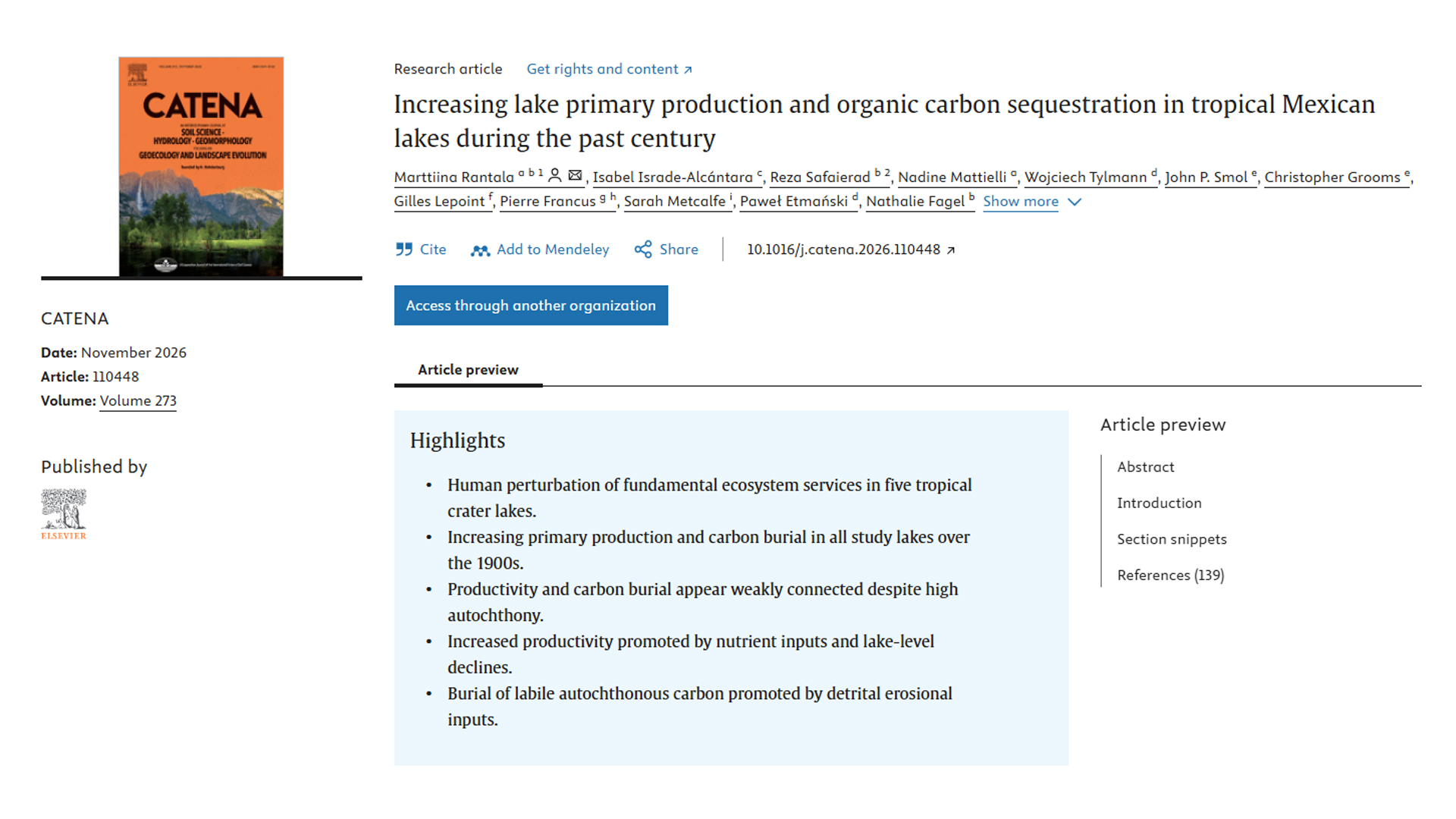
We are pleased to announce that a new publication co-authored by Wojciech Tylmann and Paweł Etmański has appeared in Catena. The study focuses on five crater lakes located within the Trans-Mexican Volcanic Belt in Central Mexico and asks how their primary production and organic carbon burial rates have changed over the past century.
All five lakes showed a consistent trend of increasing primary production and organic carbon burial, despite considerable differences in basin morphometry and in the human pressures affecting their catchments. The two processes, however, turned out to be only weakly coupled – the largest increases in primary production were associated with the smallest increases in carbon burial. The authors argue that in lakes with weak hydrological connections to their catchments, the delivery of detrital mineral material is a precondition for lasting carbon sequestration, as it helps preserve labile organic matter in the sediment.
The results show that relationships established for temperate lakes cannot simply be transferred to tropical systems – which matters for global carbon budgets.
Rantala M., Israde-Alcántara I., Safaierad R., Mattielli N., Tylmann W., Smol J.P., Grooms C., Lepoint G., Francus P., Metcalfe S., Etmański P., Fagel N., 2026, Increasing lake primary production and organic carbon sequestration in tropical Mexican lakes during the past century. CATENA 273, 110448. https://doi.org/10.1016/j.catena.2026.110448 LINK