

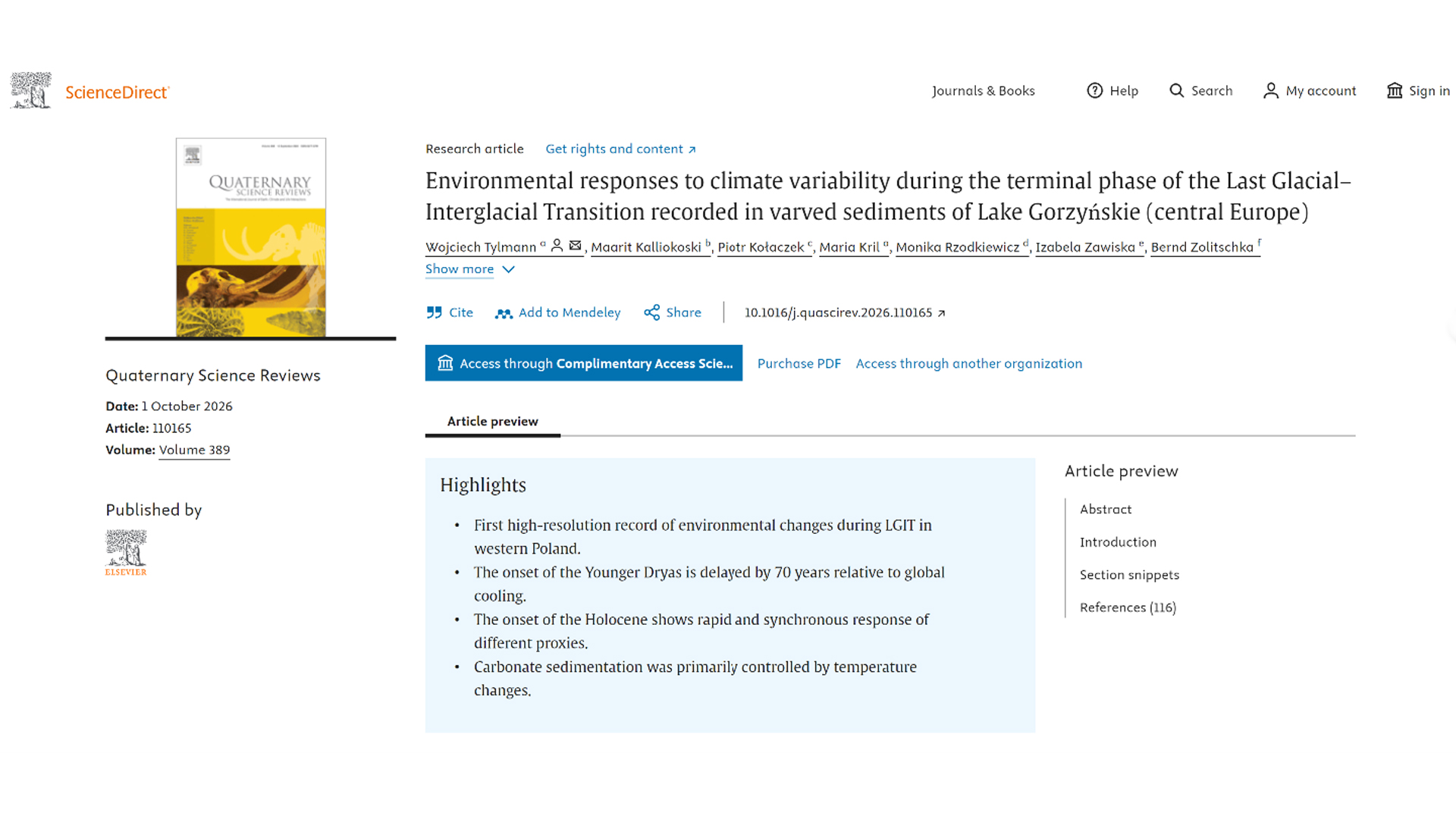
Varved sediments from Lake Gorzyńskie in western Poland form a unique archive of environmental change spanning the transition from the last glaciation to the Holocene. Detailed sedimentological, geochemical, and paleobiological analyses made it possible to trace how forests, the catchment, and the lake responded to climate change. The research shows that during cooling, vegetation changes preceded changes in the lake ecosystem – the retreat of forests increased erosion and the delivery of material to the lake, gradually altering its functioning. Conversely, the abrupt warming at the onset of the Holocene brought an almost simultaneous improvement in lake conditions, although forest recovery took around 150 years. This is the first such detailed reconstruction of late-glacial environmental change for western Poland.
The study was carried out as part of a project funded by the National Science Centre, Poland, grant no. 2020/37/B/ST10/01903.
Tylmann W., Kalliokoski M., Kołaczek P., Kril M., Rzodkiewicz M., Zawiska I., Zolitschka B., 2026, Environmental responses to climate variability during the terminal phase of the Last Glacial–Interglacial Transition recorded in varved sediments of Lake Gorzyńskie (central Europe). Quaternary Science Reviews 389, 110165. https://doi.org/10.1016/j.quascirev.2026.110165 LINK