

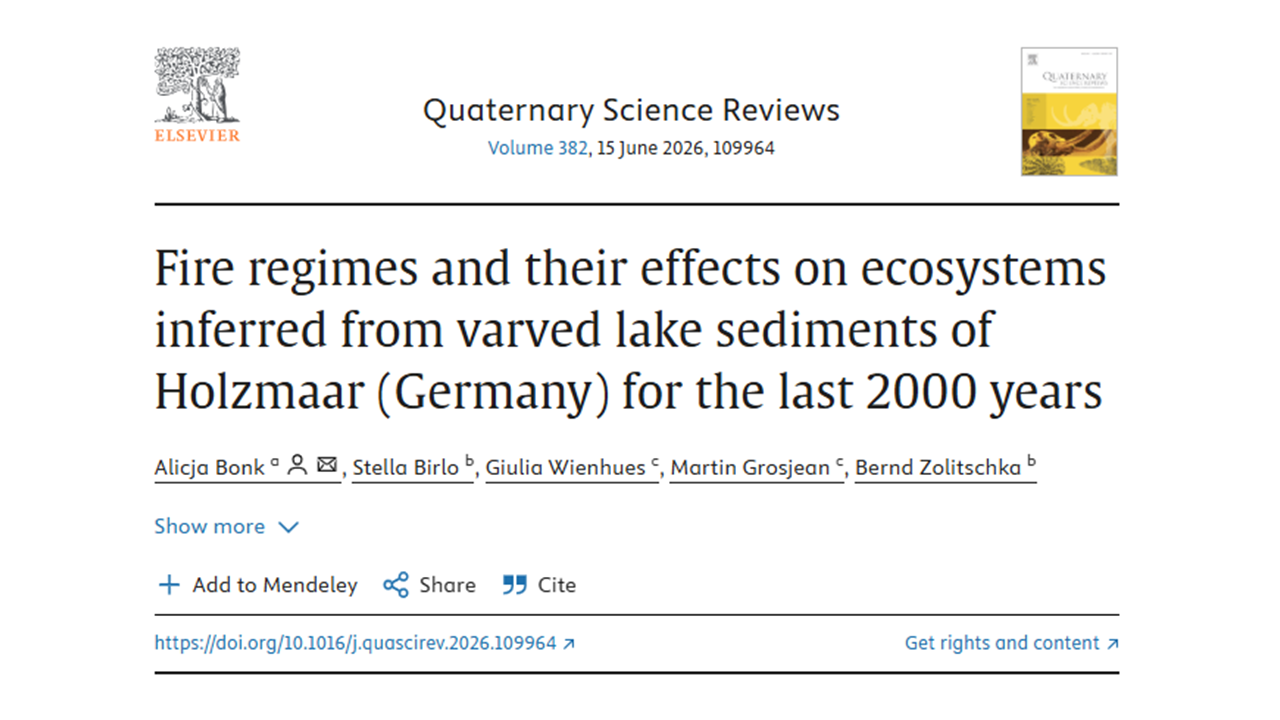
We are pleased to share news of a new article published in Quaternary Science Reviews, with Alicja Bonk as the lead author. The study presents a reconstruction of fire regime changes in the Eifel mountain region (Germany) over the past 2,000 years, based on high-resolution analyses of sediments from Lake Holzmaar.
The research combines charcoal analysis, pollen data, and geochemical indicators in a multi-proxy approach that allowed the authors to determine fire frequency, intensity, and character. The key findings indicate that fire activity was strongly linked to human activity, while climate primarily influenced fire spread and biomass availability. Surface fires of low to moderate intensity dominated the study period, and changes in the lake ecosystem were more closely related to forest cover than to fire activity itself.
Free access to the article is available for the next 50 days – we warmly encourage you to read it!
https://authors.elsevier.com/a/1msaC-4PSHW15
The research was funded by the National Science Centre, Poland (grant no. 2021/43/D/ST10/00212).
Bonk A., Birlo S., Wienhues G., Grosjean M., Zolitschka B., 2026, Fire regimes and their effects on ecosystems inferred from varved lake sediments of Holzmaar (Germany) for the last 2000 years. Quat. Sci. Rev. 382, 109964. https://doi.org/10.1016/j.quascirev.2026.109964